

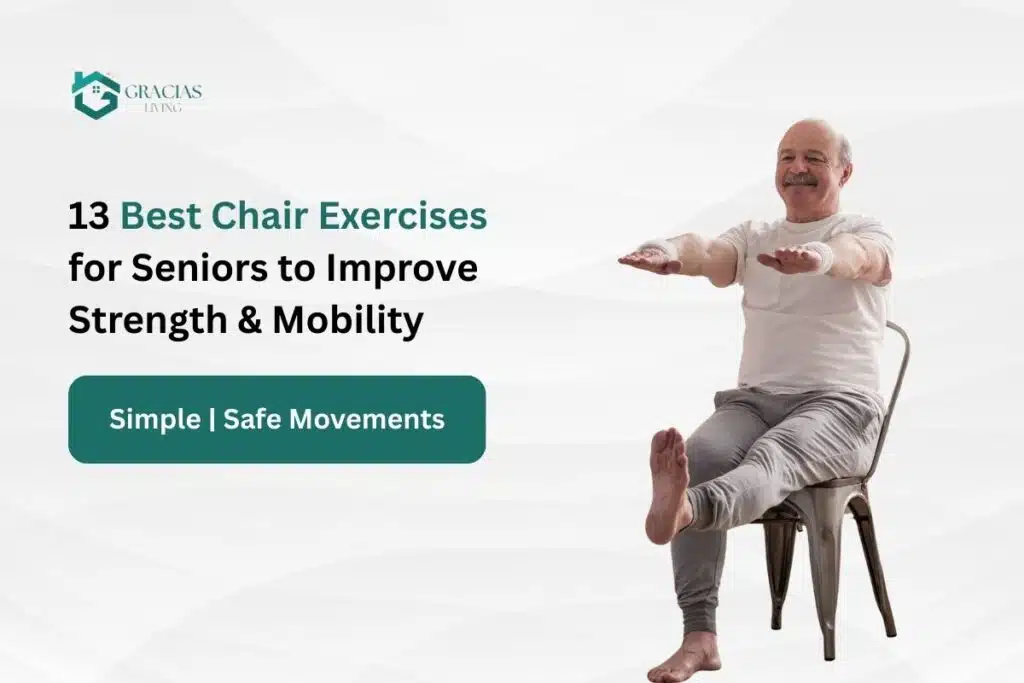
Chair exercises for seniors are easy movements that can be done while sitting down or using a chair as support. These senior chair exercises are meant to improve circulation, balance, flexibility, and strength without putting too much stress on the joints.
These exercises are best for older people and parents who need care, especially those who have trouble moving around, have arthritis, have trouble with balance, or are recovering from an illness. Most of the exercises shown and demonstrated on the chairs for older adults don’t need any equipment, aren’t too hard, and can be changed to fit different levels of fitness.
It would be hard to do standing exercises, but sitting exercises on a chair at home would be safe and effective.
Do Chair Workouts Really Work for Seniors?
Yes, chair workouts for seniors work very well when done regularly.
Your muscles don’t care whether you’re sitting or standing. They react to resistance and repetition. Even moving the joints while sitting can make them stronger, better, and get blood flowing.
Chair exercises are especially helpful for:
- Older people who have trouble with their balance
- People who are getting better after surgery or illness
- People who have arthritis or stiff joints.
- Older people who start working out again after a long break
The most important thing is to be consistent. Regular gentle movement is often better than short bursts of intense exercise.
Benefits of Chair Exercises for Seniors
Physical strength is not the only benefit of chair fitness among the seniors. It helps with both health and independence.
Improves Mobility & Joint Flexibility
Sitting exercises for older people also keep their joints flexible. Gentle knee lifts, ankle circles, and torso twists can help ease stiffness, especially in the hips, knees, shoulders, and lower back.
Over time, it might even make simple movements like getting up, turning, or reaching easier.
Builds Strength Without Strain
Chair exercises for seniors work on big muscle groups without putting too much stress on their joints. Strengthening thighs, arms, and shoulders does the following:
- Getting up from a chair
- Carrying groceries
- Going up stairs
- Unlocking doors or jars
Loss of muscle is also a common aging effect. Working with light strength decelerates that process.
Enhances Balance & Reduces Fall Risk
Even in a seated position, balance is enhanced through core muscle engagement and leg muscle strengthening. When walking or standing, leg and hip muscle strength offer more stability.
Fall risk reduction is one of the biggest benefits of chair exercises for older people.
Boosts Circulation & Heart Health
Seated marching and arm motions raise heart rate slightly. This helps to prevent stiffness caused by sitting in one position for too long.
Regular movement also helps in maintaining healthy blood pressure and cardiovascular health.
Supports Independence in Daily Activities
The stronger and more mobile a person is, the longer he is able to perform the routine of daily activities on his own – bathing, getting dressed, cooking, and cleaning.
Chair workouts reinforce that independence.
Mental Health Benefits
Movement releases endorphins. Movement endorphins, even light exercise can;
- Improve mood
- Anxiety reduction
- Build confidence
- Sleep better
By feeling capable of physical things, one is likely to feel mentally stronger as well.
How Often Should Seniors Do Chair Exercises?
For chair exercises for seniors to be a truly effective intervention, consistency is more crucial than intensity. Smaller, regular sessions are safer in building strength and mobility than too-long chair exercise sessions.
How Many Days in a Week?
Strength is gained faster by consistency than with a few long exercise sessions.
Aim for 3–5 days each week.
Start with 10–15 minutes, then add up to 20–30 minutes as stamina grows.
Smart Structure (Simple & Effective)
- 3–5 minutes warm-up at an easy pace
- 10–20 minutes strength + mobility
- Slow stretching for 3-5 minutes
Warm-Up Tip
Don’t skip it. Aging joints need gradual movement, so their stiffness can be reduced, and strain is avoided.
Begin with slow marching, rolling the shoulders, and taking deep breaths.
How to Progress Safely?
- Increase your reps by 1–2 every week
- Slow the movement instead of hurrying
- Light weights only after form feels strong
You should be able to speak while doing the exercise.
Muscle tiredness is okay — joint pain that stings is not.
Move regularly; Move gently; Make it sustainable.
List of 13 Best Chair Exercises for Seniors
Below is a practical list of chair exercises for seniors that are safe, easy, and effective at home.
1. Chair Stand
Chair stand is a lower-body strengthening exercise that imitates the natural body movement of standing up and sitting down. It can be applied to the core muscles, thighs, and hips vital to ensure independence and fall prevention.
How to do it:
- Sit straight in a strong chair (preferably without wheels).
- Keep your feet flat, hip-width apart.
- Fold your hands on your chest
- Without using your hands, slowly stand up again.
- Then, lower yourself back down in a controlled manner.
How often:
Perform 2–3 sets of 8–12 repetitions, 3–5 times per week.
2. Seated Leg Extensions
Seated leg extensions are a mild form of strengthening of the front thigh muscles (quadriceps). Well-developed quadriceps will stabilize the knees and enhance walking and stair climbing as well as standing stability.
How to do it:
- Sit with a tall posture and a straight back.
- Stretch one leg forward and make it straight.
- Hold for 2-3 seconds
- Lower the leg slowly without dropping it
- Repeat with the opposite leg
How often:
Do 10–12 repetitions per leg for 2 sets, 3–4 days per week.
3. Seated Marching
Seated marching is an exercise that strengthens the heart and the hips and is undertaken when the person is sitting. It enhances blood circulation, activates the core, and decreases stiffness, which comes as a result of long sitting.
How to do it:
- Sit straight without leaning backward
- Bring one knee up to the chest
- Slow down on lowering it
- Lift the other knee
- Continue alternating in a steady rhythm
How often:
Walking 30-60 minutes, two to five times a week.
4. Seated Heel Raises
Seated heel raises are exercises that strengthen the lower leg, working the calf muscles. The strength of the calves contributes to the stability of walking, strong ankles, and a decrease in the risk of falls.
How to do it:
- Sit upright with the feet flat on the floor
- Keep your toes firmly on the ground
- Lift both heels upward at the same time;
- Hold briefly at the top
- Let your heels down slowly and with control.
How often:
Perform 12–15 repetitions for 2 sets, 3–5 times per week.
5. Seated Toe Raises
Seated toe raises exercise the muscles on the anterior sides of the lower limbs. They are also needed to walk well since they assist in balancing the body and controlling the ankles, and facilitate safer foot placement.
How to do it:
- Sit tall, with heels firmly on the floor.
- Bring your toes up and back to the shins.
- Hold the position for 2 seconds
- Bring down your toes slowly.
- Keep your posture upright at all times.
How often:
Do 12–15 repetitions for 2 sets, 3–5 times per week.
6. Seated Biceps Curls
Seated biceps curls are a strengthening exercise of the upper body that uses the front arm muscles. Tighter biceps facilitate the process of lifting groceries, carrying objects, and other purposes.
How to do it:
- Hold light weights or water bottles
- Keep your elbows close to your sides
- Curl your hands toward your shoulders
- Pause briefly at the top
- Keep the arms down, but not swinging.
How often:
Perform 10–12 repetitions for 2 sets, 3–4 times per week.
7. Seated Shoulder Press
The seated shoulder press strengthens the shoulder and upper arm muscles. It improves the ability to safely reach overhead for shelves, cupboards, or daily activities.
How to do it:
- Hold light weights at shoulder height
- Keep your back straight and core engaged
- Press your arms upward slowly
- Avoid locking your elbows
- Lower the weights back down with control
How often:
Do 8–10 repetitions for 2 sets, 2–3 times per week.
8. Seated Torso Twists
Seated torso twists improve spinal mobility and engage the core muscles. This movement helps maintain flexibility for turning, reaching, and performing daily functional tasks.
How to do it:
- Sit tall with arms crossed over your chest
- Slowly twist your upper body to one side
- Keep your hips facing forward
- Return to the center
- Repeat on the opposite side
How often:
Perform 10 repetitions per side for 2 sets, 3–4 times per week.
9. Seated Side Bends
Seated side bends stretch the muscles along the waist and sides of the torso. This exercise improves flexibility and makes side-reaching movements more comfortable.
How to do it:
- Sit upright with both feet flat
- Raise one arm overhead
- Gently lean toward the opposite side
- Hold for 10–15 seconds
- Return to the center and switch sides
How often:
Repeat 3 stretches per side, 3–5 times per week.
10. Seated Hamstring Stretch
The seated hamstring stretch stretches out the muscles in the thighs behind. Plastic hamstring helps to ease the lower back pain and walk more comfortably.
How to do it:
- Sit upright and extend one leg forward
- Keep your heel on the floor
- Lean slightly forward from your hips
- Keep your back straight
- Hold for 15–20 seconds
How often:
Repeat 2–3 times per leg, 3–5 times per week.
11. Chest Stretch
The chest stretch loosens tight chest and shoulder muscles that have accrued as a result of sitting. It enhances the sitting position and adopts flattened shoulders.
How to do it:
- Sit near the edge of the chair
- Clasp your hands behind your back
- Gently lift your hands upward
- Open your chest and shoulders
- Hold the position steadily
How often:
Hold for 15–20 seconds and repeat 2–3 times, 3–5 days per week.
12. Ankle Circles
Ankle circles enhance the mobility of the joints and blood flow of the lower legs. Powerful upper back muscles enhance the posture and decrease the strain of shoulders.
How to do it:
- Sit upright and lift one foot slightly
- Rotate your ankle in a slow circular motion
- Complete 10 rotations
- Reverse the direction
- Switch to the other foot
How often:
Perform 10 circles in each direction per foot, 3–5 times per week.
13. Seated Reverse Fly
The seated reverse fly strengthens the upper back and rear shoulder muscles. Strong upper back muscles improve posture and reduce shoulder strain.
How to do it:
- Hold light weights in both hands
- Lean slightly forward from your hips
- Extend your arms downward
- Open your arms out to the sides
- Squeeze your shoulder blades together
How often:
Perform 8–12 repetitions for 2 sets, 2–3 times per week.
Common Mistakes Seniors Should Avoid
Chair exercises for seniors are safe — but only when done with proper form and awareness. Avoiding these common mistakes helps prevent injury and ensures better results.
Poor Posture
Slouching while exercising reduces muscle engagement and places unnecessary strain on the lower back and neck.
When posture collapses, the core muscles stop working effectively.
Always sit tall with your shoulders relaxed and your spine in a neutral position.
Holding Breath
Seniors do not realize that they are holding their breath when exerting themselves, particularly when lifting or standing.
This may lead to acute blood pressure and vertigo.Breathe in when the action of movement is straining and out when reclining to the initial position.
Moving Too Fast
Rushing through exercises reduces muscle control and increases the risk of strain.
Quick movements are based on momentum rather than the strength of muscles. Slower but controlled movement is more effective and safer in increasing strength.
Ignoring Pain Signals
Mild muscle fatigue is normal, but sharp or stabbing pain is not.
Exercising with joint pains may aggravate other existing diseases, such as arthritis.
If pain occurs, stop immediately and reassess your form or reduce intensity.
Using Unstable Chairs
Chairs with wheels or soft cushions can shift during movement.
Instability increases the risk of slipping or losing balance.
Always use a firm, sturdy chair placed on a non-slip surface.
Tips to Get the Most Out of Chair Workouts
Chair workouts for seniors are simple — but small adjustments can make them far more effective. These practical tips help improve results, prevent boredom, and build long-term consistency.
Focus on Proper Breathing Technique
Breathing correctly improves oxygen flow and prevents dizziness.
Exhale during the effort (when lifting or pushing) and inhale as you return to the starting position.
Never hold your breath — steady breathing keeps blood pressure stable, and movements controlled.
Exercise at the Same Time Each Day
Routine builds habit, and habit builds results.
Choosing a consistent time — such as after breakfast or before dinner — increases long-term adherence.
When exercise becomes part of the daily schedule, it feels automatic rather than optional.
Use Music, Timers, or Counting Cues
Light music can improve rhythm and make sessions more enjoyable.
Using a timer prevents undertraining or overdoing exercises.
Counting out loud also helps maintain steady pacing and proper breathing.
Prioritize Controlled Movements Over Speed
Moving slowly increases muscle engagement and reduces joint strain.
Fast repetitions rely on momentum instead of strength.
Focus on smooth, deliberate movements for better results and safety.
Progress Gradually
Small improvements are safer and more sustainable than sudden increases.
Add 1–2 repetitions or extend hold times slightly each week.
Avoid jumping to heavier weights until form feels strong and stable.
Combine Strength + Mobility in the Same Session
Strength exercises build muscle, while mobility movements maintain joint flexibility.
The combination of the two provides balanced fitness and enhanced functional mobility.
A well-rounded session reduces stiffness and improves daily independence.
Conclusion
You don’t stop moving because you age.
You age faster when you stop moving.
These chair exercises benefit the seniors by demonstrating that being strong does not need a gym but consistency. Ten focused minutes a day can protect your balance, support your joints, and help you stay independent longer. That’s powerful.
Forget intensity. Choose steady progress. Choose safe movement. Choose control over comfort.
Every sit-to-stand. Every stretch. Every slow repetition adds up.
Start where you are. Stay consistent. Let momentum build.
If you’re ready, download a simple weekly routine or explore our related guides to keep your chair workouts structured and sustainable.
Frequently Asked Questions
1. What is the best free chair exercise for seniors?
Chair stands are often considered one of the best free chair exercises for seniors. They strengthen the legs and directly improve the ability to stand up independently.
2. What is the best time to do chair exercises?
Morning is ideal for reducing stiffness, but the best time is whenever energy levels are highest. Consistency matters more than timing.
3. Can seniors lose weight with chair exercises?
Yes, when combined with proper nutrition. Chair workouts burn calories and build muscle, which supports metabolism. However, weight loss depends on overall lifestyle.
4. Are chair exercises safe for people over 70 or 80?
Generally, yes — especially when low-impact and performed with proper form. Seniors with medical conditions should consult a healthcare professional before starting.