
Last reviewed 20 August 2026 by Dr. Vishal Siwach, Co-Founder and COO, Gracias Living. Admission timelines and care descriptions reflect current practice at both Gurgaon residences.
If your parent is being discharged and cannot manage at home, you have three realistic options in Gurgaon: bring them home with a trained attendant, move them into short-term residential recovery care, or take them home unsupported and hope the first fortnight goes well. Most families decide within 48 hours, which is why it helps to understand the three before the discharge call comes.
Hospitals discharge patients when they are medically stable, not when they are recovered. Those are different things, and the gap between them is where most families get caught.
Your father has had a stroke, or a hip replacement, or a long stay for a chest infection. The doctor says he is doing well and the bed is needed. You are relieved for about ten minutes, and then you start thinking about the third-floor flat with no lift, the bathroom with no grab rail, the eleven medicines on a new schedule, and the fact that everyone in the house leaves for work at nine.
Two or three families arrive at Gracias Living every month directly from a hospital discharge. This is written from those conversations.
The first two weeks are the risky part
Recovery after a hospital stay is not a straight line, and the period immediately after discharge is when things go wrong. Falls happen in unfamiliar circumstances — a parent who managed the stairs easily two months ago is now weaker, possibly on medication that affects balance, and unwilling to admit either. Medication schedules change on discharge, often substantially, and the person managing them is usually a family member who received a hurried explanation in a corridor. Wounds need watching. Physiotherapy needs doing daily, not when someone remembers.
None of this is dramatic. It is just relentless, and it lands on a family that is already exhausted from the hospital stay itself.
Your three options, honestly compared
| Option | Works well when | Falls short when | Typical cost |
|---|---|---|---|
| Home with a trained attendant | Recovery is straightforward, the home is accessible, and someone in the family can supervise the attendant | Nursing tasks are involved, the attendant is untrained or unreplaced when absent, or nobody is home during the day | Roughly ₹25,000–₹40,000 a month, plus equipment |
| Short-term residential recovery | Recovery needs daily physiotherapy, medication supervision and observation, and the family cannot provide continuous cover | The parent is strongly opposed to leaving home, or recovery is expected to take only a few days | From ₹5,000 a day; ₹1,30,500 a month, or ₹1,50,000 with daily physiotherapy |
| Home with family support only | Recovery is minor, the home is already suitable, and an adult is present through the day | Anyone in the household works full time, or the parent needs help at night | No fee, high family cost |
The honest version of this comparison is that all three work in the right circumstances. The mistake families make is choosing based on the parent they had last year rather than the parent being discharged this week.
How to judge which one you need
Before the discharge, get five minutes with the treating doctor or the ward sister and ask these questions. Write the answers down — you will not remember them.
- What can he do unaided today — walk, use the bathroom, get out of bed at night?
- What has changed in his medication, and who is going to manage the new schedule?
- Does he need physiotherapy, how often, and for how long?
- What are the warning signs that should bring him back to hospital?
- Realistically, how many weeks until he is back to where he was?
If the answer to the first question involves someone helping him, and the answer to the last question is more than two weeks, home with occasional family support is unlikely to be enough.
What residential recovery care actually involves
Short-term residential care sits between hospital and home. The person is no longer receiving acute treatment, but they are still being observed rather than left alone.
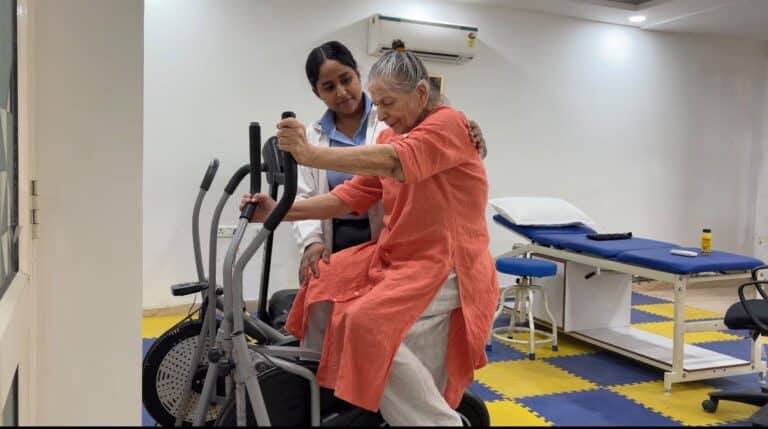
At Gracias Living that means nursing staff through the day and night, doctors on rounds, physiotherapy built into the daily routine rather than arranged separately, medication managed by staff rather than by a family member reading a discharge summary, and meals adapted to whatever the recovery requires. Clinical needs are assessed case by case before admission, so a family can find out quickly whether we are the right fit rather than after moving in.
Families usually stay involved more than they expect, not less. Most visit several times a week in the early period.
How quickly this can happen
This is the question families ask first, because a discharge date rarely comes with much warning.
- You visit. Usually one or two days before discharge, while the parent is still in hospital. You see the residence, meet the team and discuss what the recovery needs.
- We agree the care and the cost. Admission forms, any medical equipment required, and the fee for the expected length of stay.
- Payment is completed.
- Your parent moves in. Within 12 to 24 hours of payment. Many residents come directly from the hospital rather than going home first.
If the discharge is sudden, call before you visit and we will tell you honestly whether we can take an admission that quickly.
Cost, and why length of stay matters
Recovery care is billed either daily or monthly, depending on what the family needs. Daily billing suits short recoveries and palliative situations where the length of stay is genuinely uncertain. Monthly billing suits recoveries measured in weeks.
Daily rates for post-hospitalisation care start from ₹5,000. Monthly, recovery care with nursing and attendant support is ₹1,30,500, and ₹1,50,000 where daily physiotherapy is part of the plan. Full pricing is published here — we would rather want you see it before you call. Full pricing is published here — we would rather you see it before you call.
Compared against a trained attendant at home, the monthly figures are higher. What they include is different: nursing cover that does not call in sick, physiotherapy that happens whether or not someone chases it, and doctors who see your parent without an appointment being made.
Matching the situation to the right care
Different discharges need different things.
- After surgery — hip and knee replacements, abdominal surgery, cardiac procedures. Recovery typically runs six to twelve weeks. See post-operative care.
- After a stroke — the first three to six months carry the most recovery potential, and daily structured therapy matters more here than anywhere else. See stroke rehabilitation.
- A short stay while the family arranges something longer — or while a primary carer travels or recovers themselves. See short-term stay and respite care.
- When treatment has moved to comfort — pain and symptom management, with family present. See palliative care.
Where we are
Gracias Living has two residences in Gurgaon. Blossom in Sector 43 and Zinnia in DLF Phase 3. Both sit inside Gurgaon’s hospital belt, within a short drive of Paras, Fortis Memorial, Artemis and Medanta — which matters if your parent needs to go back for a follow-up, or unexpectedly.
Facing a discharge this week?
Call and describe the situation. If we are not the right fit we will say so, and point you somewhere that is.
Questions families ask when a parent is being discharged
At Gracias Living, within 12 to 24 hours of the admission being completed. Most families visit one or two days before discharge, complete the forms, agree on the care and cost, and their parent moves in directly from the hospital.
Yes. Recovery care is billed daily or monthly depending on what the family needs. Daily billing starts from ₹5,000 and suits short recoveries or situations where the length of stay is uncertain.
On the monthly figure, usually yes; a trained attendant costs roughly ₹35,000 to ₹40,000. Post-surgery recovery care at Gracias Living is ₹1,30,500 a month with nursing and attendant support, or ₹1,50,000 a month where daily physiotherapy is part of the recovery plan. Daily billing starts from ₹5,000. The difference is what the fee covers: nursing cover with no gaps when someone is unwell or absent, physiotherapy that happens on schedule rather than when it gets arranged, doctors on rounds, and meals and medication managed by staff instead of by a family member.
What they can do unaided today, what has changed in their medication and who will manage it, whether physiotherapy is needed and how often, what warning signs should bring them back, and how many weeks recovery is expected to take.
After surgery, typically six to twelve weeks. After a stroke, the first three to six months carry the most recovery potential, which is why daily structured therapy matters most in that window.