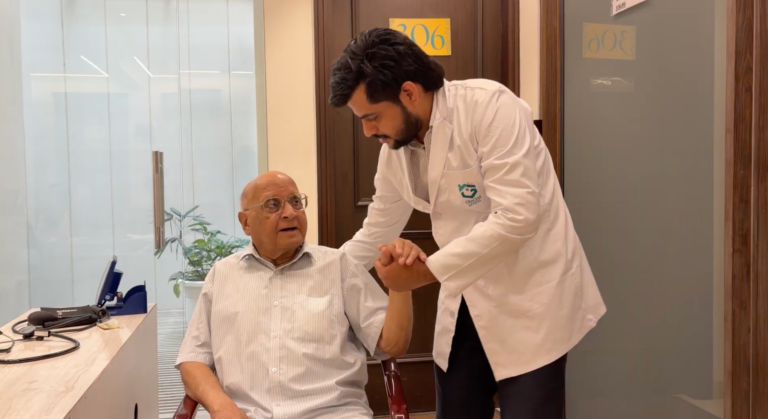

🩺 Medical Guidance: Dr. Chitra Anand, Head of Medical Services, Gracias Living
📅 Last Updated: 27 July 2026 by Gracias Living Editorial Team
Dementia Behavioral Crisis Guide for Families
Your Parent Isn’t “Difficult.”
They’re Living Through a Disease.
A dementia behavioral crisis may involve aggression, suspicion or refusal of care when your parent feels frightened, confused, uncomfortable or unable to communicate an unmet need.
A dementia behavioral crisis may involve sudden aggression, agitation, suspicion, wandering or refusal of care. What works is identifying the trigger, checking for medical causes, reducing environmental stress and responding with calm, personalised support. Medication may sometimes help, but it should not be the only response.
What Families Should Remember
🧠 Behaviour communicates: Look for fear, pain, confusion or an unmet need.
🔍 Find the trigger: Check for illness, dehydration, medication changes, poor sleep or excessive noise.
🗣️ Reassure instead of arguing: Respond to the emotion rather than correcting every fact.
🩺 Take sudden changes seriously: New or severe behavioral symptoms need medical assessment.
Your parent is not giving you a difficult time. They are having a difficult time.
Your Parent Is Not Choosing This Behaviour
Yesterday, your father shouted at the caregiver who tried to help him bathe.
Today, your mother refuses to eat because she believes the food has been poisoned.
A few days ago, your parent accused you of stealing money or trying to harm them.
You no longer recognise the person standing in front of you.
If you are living through this, you are probably exhausted. You spend each day trying to protect your parent while wondering what happened to the kind and loving person you have always known.
When you lose patience, guilt follows.
When you consider professional dementia care, you wonder whether you are giving up.
You also worry that the aggression will worsen, someone may get hurt, or your parent is suffering in a way they cannot explain.
Here is the truth every family needs to hear:
Your parent is not giving you a difficult time. They are having a difficult time.
Dementia can affect judgement, communication, emotional regulation and impulse control. Your parent is not choosing to become aggressive, suspicious, restless or withdrawn.
Their brain is changing. Their behaviour may be the only way they can communicate that something feels wrong.
At Gracias Living, we regularly meet families facing these difficult situations. We understand how frightening and isolating this stage can feel.
We also know that behavioral improvement is possible.
It does not come from one magic treatment. It begins when medical assessment, a supportive environment, predictable routines and personalised dementia behaviour management work together.
Why Does a Dementia Behavioral Crisis Happen?
A dementia behavioral crisis usually happens when changes in the brain combine with fear, physical discomfort, confusion or an overwhelming environment. The behaviour may appear sudden, but there is often an unmet need or trigger behind it.
One of the biggest misconceptions about dementia is that behavioral changes reveal a person’s true personality.
They do not.
As dementia progresses, the brain may struggle to interpret people, places and everyday situations. Something that feels ordinary to you may feel unfamiliar or threatening to your parent.
Imagine feeling confused, unable to understand what’s happening around you, and not having the words to explain it. Sometimes those feelings come out as anger, resistance, or withdrawal.
Common Triggers Behind Behavioral Changes
| Possible Trigger | What You May Notice |
|---|---|
| 🩹 Pain or illness | Agitation, shouting, restlessness or resistance to care |
| 🥤 Hunger or dehydration | Irritability, weakness, confusion or refusal to cooperate |
| 🩺 Constipation or urinary infection | Sudden aggression, distress or unusual behaviour |
| 💊 Medication side effects | Drowsiness, agitation, confusion or changes in sleep |
| 🔊 Noise and overstimulation | Pacing, shouting, withdrawal or attempts to leave |
| 👥 Unfamiliar people or surroundings | Suspicion, fear, repeated questions or resistance |
| 🕒 Change in routine | Anxiety, disturbed sleep or increased confusion |
| 💬 Poor communication | Frustration, refusal or defensive behaviour |
A sudden behavioral change should never be dismissed as “just dementia.” It may be the first visible sign of pain, infection, dehydration, or another medical concern.
The World Health Organisation recommends a physical assessment and medication review when a person with dementia develops behavioral symptoms. The Alzheimer’s Association also advises families to consider discomfort, overstimulation, tiredness, hunger, thirst and medication side effects.
🚨 When Does a Behavioral Change Need Medical Attention?
Seek prompt medical advice if the behaviour changes suddenly or becomes unusually severe, especially with:
• Fever, pain or difficulty passing urine
• Extreme drowsiness or sudden confusion
• A fall or possible head injury
• Refusal of food or fluids
• New hallucinations or severe disorientation
• Difficulty breathing or swallowing
• Behaviour that places anyone in immediate danger
A sudden change should never be dismissed as “just dementia.” Pain, infection, dehydration or medication side effects may be contributing.
Emotional and Environmental Triggers Matter Too
Imagine waking up in a place you do not fully recognise.
People are asking questions you cannot answer. Someone is trying to remove your clothes for a bath. You cannot remember who they are or why they are touching you.
Resistance may be a form of self-protection.
A loud television, several people speaking at once, unfamiliar visitors, or a hurried caregiver can overwhelm a brain that is already struggling to process information.
At Gracias Living in Gurgaon and Delhi NCR, we have found that behavioral challenges often become harder when families lack access to professional dementia behaviour management. Families are doing everything they can, but love alone cannot provide medical knowledge, trained responses, and consistent structure.
When the right support is introduced, the pattern can begin to change.
Key Insight: Before asking, “How do we stop this behaviour?” ask, “What is my parent trying to communicate?
How Family Responses Can Unintentionally Escalate the Crisis
Families Naturally Try to Explain
You may find yourself saying:
These statements are logical, but a person living with dementia may not be able to process them in the same way.
These statements are factually correct, but a person living with dementia may no longer be able to process them logically.
Correcting, confronting, or repeatedly questioning your parent can make them feel ashamed, cornered, or frightened.
A Difficult Cycle Can Begin
Breaking this cycle begins with a different response: less correction, more reassurance; less urgency, more patience; less focus on facts, more attention to feelings.
Your parent is not broken.
But the care approach or environment may no longer match what their changing brain needs.
What Doesn’t Work During a Dementia Behavioral Crisis
During a dementia behavioral crisis, arguments, force, unnecessary sedation and an unpredictable routine can increase fear and distress.
Families often try every possible solution before asking for professional help. However, medication alone, arguments, force, isolation and an unpredictable routine can increase fear and make the behaviour harder to manage.
When Does a Behavioral Change Require Urgent Medical Attention?
Seek prompt medical advice if your parent’s behaviour changes suddenly or becomes unusually severe.
Warning signs may include:
- Sudden confusion or extreme drowsiness
- Fever, pain or difficulty passing urine
- A fall or possible head injury
- Refusal of food or fluids
- New hallucinations or severe disorientation
- Difficulty breathing or swallowing
- Repeated vomiting or diarrhoea
- A sudden medication-related change
- Behaviour that places your parent or others in immediate danger
A sudden change should never be dismissed as “just dementia.” Infection, pain, dehydration, constipation, medication side effects, or another medical condition may be contributing to the behaviour.
What Actually Works During a Dementia Behavioral Crisis?
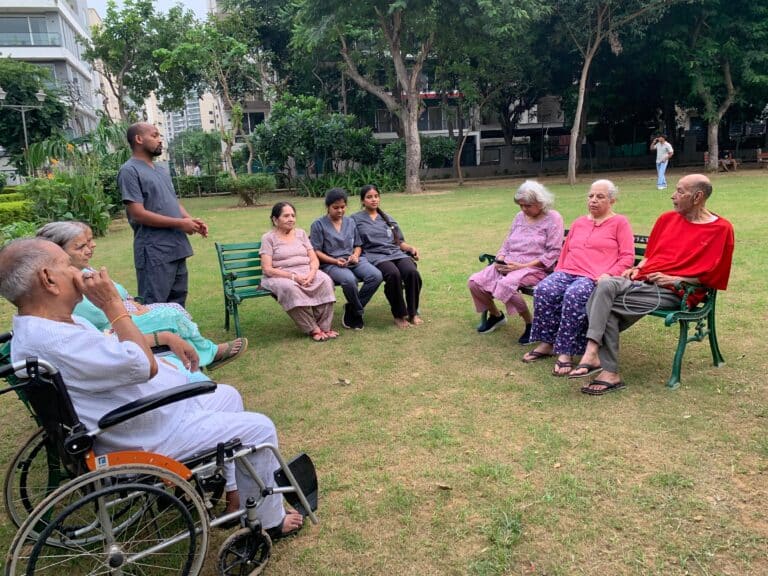
Behavioral improvement becomes more likely when medical assessment, familiar routines, meaningful engagement and a supportive environment work together.
Families Often Ask Us
“What changed?”
The answer is rarely one treatment. At Gracias Living, we support the whole person instead of responding only to visible symptoms.
For families seeking dementia care in Gurgaon and Delhi NCR, the difference lies in coordinated care that understands the person, identifies the trigger and responds with consistency.
Gracias Living’s Internal Care Outcomes
80–90%
of residents demonstrate observable behavioral improvement
✓ Families often notice positive changes within 3–6 months.
✓ Significant changes may appear during the first three months.
✓ Families report reduced distress, better engagement and visible mood changes.
✓ Progress is monitored through everyday behaviour, participation and family feedback.
What Behavioral Improvement May Look Like
🌱 Withdrawn → participating in suitable activities
🕊️ Frequently distressed → calmer and more settled
🤝 Socially isolated → interacting with residents and caregivers
😊 Low in mood → smiling, laughing and showing interest
🏡 Anxious or insecure → feeling safer in familiar surroundings
Behavioral improvement does not mean dementia has reversed. It means the resident may feel calmer, safer and more connected in an environment that better supports their needs.
Based on Gracias Living’s internal resident observations and family feedback. Individual needs, responses and timelines vary. These figures are not a guarantee of outcome.

Medical Leadership
Dr. Chitra Anand
Head of Medical Services, Gracias Living
38+ years of clinical experience
Dr. Chitra Anand and the care team oversee residents’ health, medication and behavioral progress. Their approach considers physical health, routine, nutrition, environment and everyday functioning, not medication alone.
Behavioral decisions should be guided by medical judgement, careful observation and respect for the resident.
Can Behaviour Improve With Specialised Dementia Care?
Yes. Behavioral symptoms can sometimes become less frequent or easier to manage when medical concerns, routines, communication and environmental triggers are addressed.
However, every person’s condition and response are different. Dementia cannot be reversed, and no care provider should guarantee a specific outcome or timeline.
Based on documented observations at Gracias Living, approximately 80-90% of residents show measurable behavioral improvement within 3-6 months of settling into structured dementia care. While every person progresses differently, families consistently report positive changes in their parent’s engagement, mood, and behavioral stability.
The right response to a dementia behavioral crisis begins with understanding the person, identifying their triggers and creating consistency around them.
The Change Is Often Felt by the Whole Family
The resident is not the only person affected by specialised care. Adult children tell us they can finally sleep without worrying about what might happen during the night.
Spouses can return to being husbands or wives instead of carrying every medical and caregiving responsibility alone.
Family visits may become calmer because time together is no longer dominated by medication, meals, bathing and behavioral distress.
The guilt does not disappear immediately. But many families gradually realise that they did not abandon their parent.
They found a level of support that had become difficult to provide safely at home.
How to Know When Your Parent Needs Specialised Dementia Care
Your parent may need specialised dementia care when behavioral symptoms, wandering, medication errors or resistance to daily care can no longer be managed safely and consistently at home.
There is no perfect moment to make this decision. However, the following signs may indicate that your parent and family need more support.
💛 Your Wellbeing Matters Too
Ask yourself these questions honestly:
□ Am I constantly anxious about leaving my parent alone?
□ Am I sleeping properly?
□ Is caregiving affecting my health, work or marriage?
□ Do we spend every day reacting to the next crisis?
□ Can I safely meet my parent’s present needs at home?
If the honest answer is no, asking for help is not a failure.
It may be one of the most responsible and loving decisions you make for your parent and your family.
Why Early Support Can Make a Difference
Families do not need to wait for a serious emergency before exploring professional support.
Early intervention gives the care team time to understand routines, communication patterns, preferences and triggers before the symptoms become more difficult to manage.
It may also make the transition easier while your parent can still respond to familiar routines, relationships and meaningful engagement.
Speaking to a dementia care professional does not commit you to immediate admission. It can simply help you understand the available choices and prepare for the next stage.
Why Families Trust Dr. Chitra Anand at Gracias Living
Every resident living with dementia at Gracias Living receives medical oversight from Dr. Chitra Anand, Head of Medical Services.
With more than 38 years of clinical experience, she brings extensive knowledge of geriatric health and the complex medical concerns that can accompany dementia.
Her approach considers more than medication. She evaluates the interaction between physical health, behaviour, routine, environment, nutrition and everyday functioning.
The care process includes:
- Reviewing medical history and current medication
- Monitoring new or changing health concerns
- Assessing behavioral patterns
- Looking for pain, infection and other possible triggers
- Reviewing treatment according to the resident’s response
- Coordinating with caregivers and nursing staff
- Keeping families informed about important developments
Behavioral decisions should never be driven by frustration or convenience. They should be guided by careful observation, medical judgement and respect for the resident.
What Does Dementia Care Cost at Gracias Living?
Intermediate Dementia Care
₹90,500 / month
Structured support, nursing supervision, medication management and personalised engagement.
Extensive Dementia Care
₹130,500 / month
Higher supervision for complex behavioral, medical and daily-care needs.
Refundable security deposit: ₹3,75,000. Final charges are confirmed after assessment. Taxes and additional clinical services may apply.
Schedule a Dementia Care Assessment
The first step is a conversation.
Our team will review your parent’s medical history, medication, behavioral concerns and daily care needs to help you understand whether specialised dementia care is appropriate.
If possible, bring:
✓ Recent medical records and hospital summaries
✓ Current medication list
✓ Notes about recent behavioral changes
✓ Information about sleep, meals, mobility and personal care
✓ Details of situations that commonly cause distress
There is no obligation and no pressure—just an honest conversation about what may help your parent and family.
Your Parent Deserves Better Days. So Do You.
A dementia behavioral crisis does not mean hope has disappeared or that your parent’s personality has been lost.
A dementia behavioral crisis does not mean that hope has disappeared.
Your parent may still experience comfort, familiarity, connection and moments of happiness when the care around them matches their changing needs.
The right medical support, structured routine, meaningful engagement and compassionate dementia behavior management can make everyday life safer and more manageable.
At Gracias Living, our goal is not to control a person’s behaviour.
Our goal is to understand the person behind it.
Because your parent deserves dignity and thoughtful care.
And your family deserves support, clarity and peace of mind.
Continue Reading
Families may also find these Gracias Living resources helpful:
- Learn about our specialised dementia care in Gurgaon.
- Read how to deal with aggression in a person living with dementia.
- Explore therapies and activities for people with dementia.
Frequently Asked Questions About a Dementia Behavioral Crisis
1. What is a dementia behavioral crisis?
A dementia behaviuoral crisis is a severe or sudden episode of agitation, aggression, suspicion, wandering, hallucination or refusal of care. It often signals fear, pain, illness, confusion, overstimulation or another unmet need.
2. What should I do when a person with dementia becomes aggressive?
Stay calm, lower your voice and give the person physical space. Remove immediate dangers, reduce noise and avoid arguing. Once the situation settles, look for possible triggers such as pain, hunger, infection, tiredness or unfamiliar surroundings.
3. Can a urinary infection cause sudden behavioral changes?
Yes. A urinary infection, dehydration, constipation, pain or medication side effects can cause sudden confusion or unusual behaviour in an older adult. Seek medical advice if the change appears suddenly or is significantly different from the person’s usual behaviour.
4. Should I correct my parent when their belief is not true?
Avoid repeatedly correcting or confronting them. A person living with cognitive decline may not process facts as expected. Acknowledge the emotion, offer reassurance and gently redirect their attention to something familiar or comforting.
5. Can behavioral symptoms improve with specialised dementia care?
Behavioral symptoms may become less frequent or easier to manage when medical causes, communication difficulties, routines and environmental triggers are addressed. However, every person responds differently, and no provider should guarantee a specific outcome or timeline.
6. Is medication necessary for dementia aggression?
Medication may be appropriate in some situations, especially when symptoms create serious distress or safety risks. However, it should follow a medical assessment and should not replace personalised care, calm communication, meaningful engagement and environmental changes.
7. How do I know when home care is no longer enough?
Home care may no longer be enough when your parent wanders, frequently refuses essential care, misses medication, becomes unsafe, requires continuous supervision or has needs the family cannot manage consistently. Caregiver exhaustion is also an important warning sign.
8. What does specialised dementia care include at Gracias Living?
Specialised dementia care at Gracias Living includes 24-hour nursing support, medication management, structured routines, personalised engagement, behavioral monitoring, nutritious meals and medical oversight. The care plan depends on each resident’s health, mobility, behaviour and daily support needs.