

I spent most of my career as a gynecologist, delivering babies and caring for women through every stage of life. Medicine teaches you the same core lesson no matter which specialty you practice in, and it applies just as much to caring for a parent with dementia. Listen closely, treat the person and not just the diagnosis, and never assume one patient’s experience will match another’s.
I have sat with families on the worst day of their lives. The day they realize their mother no longer recognizes the kitchen she cooked in for forty years. The day their father asks the same question five times in ten minutes. Thirty eight years in medicine, and the last few years spent focused on senior care, have taught me that dementia is not one disease with one shape.
Here is what those years actually taught me, the parts no textbook covers.
Routine can be as important as medication in day to day dementia care
Medication can help manage symptoms. Routine shapes the day. A person with dementia loses their grip on time and place long before they lose their personality. The same breakfast at the same hour, the same chair by the same window, the same voice saying good morning. These small repetitions hold a person steady when their own mind cannot.
Families often ask me what drug will help the most. My honest answer is a clock and a calendar used the same way every single day. However, this does not replace medication. Prescribed treatment and routine work together, and each does something the other cannot.
What caring for a parent with dementia asks of the whole family
A daughter caring for her father will lose sleep, lose patience with herself, and often lose her own health while she focuses entirely on his. I have watched this happen more times than I can count. For this reason, good dementia care treats the whole family, not just the diagnosis.
At Gracias Living, we sit down with every family and walk them through what to expect at each stage. Not to frighten them. To prepare them, so they are never caught off guard by a change we could have warned them about.

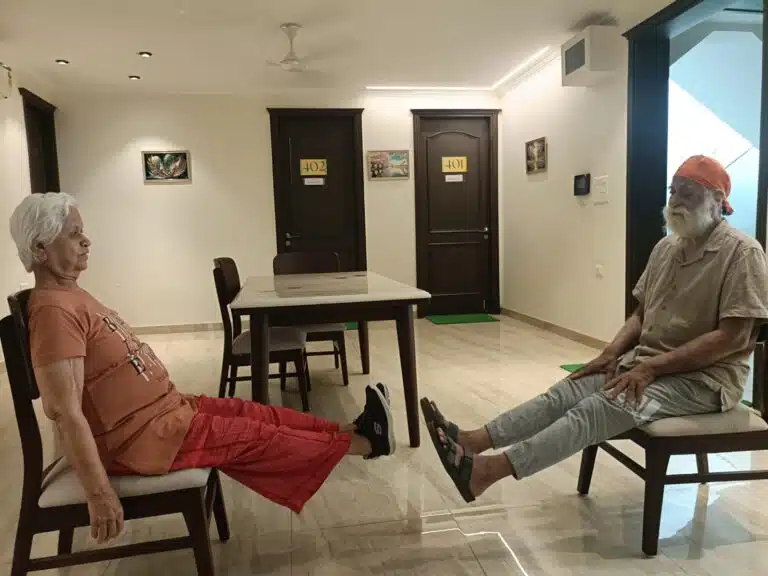
Residents at Gracias Living, spending an afternoon together
The right environment can shape behavior
Agitation, wandering, and confusion are often blamed on the disease alone. In my experience, the environment plays an equally large role. For example, harsh lighting, unfamiliar layouts, and constant noise can turn a calm afternoon into a distressing one.
For this reason, we design every space at our centers with calm in mind. Clear sightlines, consistent layouts, natural light, and quiet corners for the moments a resident needs to step away from stimulation. A calmer environment can reduce distress and agitation for many people with dementia.
Every decline moves at its own pace
Two people with the same diagnosis can decline in completely different ways over completely different timelines. I stopped comparing patients to each other decades ago, and I ask families to do the same. Comparing your parent’s stage to another family’s experience only adds guilt to an already heavy load. The Alzheimer’s Association notes that stages are a general guide, not a fixed timeline every person follows.
Instead, track the person in front of you. Is your parent eating well this week? Sleeping through the night? Still recognizing the people who matter to them? Those answers guide the plan, not a chart from a book.
What these lessons built at Gracias Living
Every part of our dementia program grew out of moments like these, learned across a career spent listening closely to families who are caring for a parent with dementia. Structured daily rhythms. Spaces built for calm, not just for supervision. Medical oversight that adjusts as a resident changes, not a plan fixed on day one. And a promise to every family that they will never walk this path without someone explaining the next step before it arrives.
Questions families ask us about dementia care
Deciding on the right care
How do I know it is time to look beyond home care?
Watch for safety incidents like falls, wandering, or missed medications, along with a caregiver who is exhausted or unwell. When home care starts to feel unsafe or unsustainable for either the resident or the family, it is time to explore other options. This is rarely a single moment. Instead, it is usually a pattern that becomes clear over a few weeks.
Is a residential dementia care program better than hiring a caregiver at home?
It depends on the stage and the needs of the resident. A dedicated home caregiver can work well in early stages. A residential program becomes valuable once medical oversight, a structured environment, and round the clock supervision matter more than familiar surroundings alone. We talk families through this decision honestly instead of pushing one answer.
Daily life and behavior
Will my parent forget who I am?
Recognition can fade in later stages, but connection does not disappear the same way. Families often see a parent respond to their voice, touch, or presence even when names are gone. We encourage families to keep visiting and keep engaging, since familiarity still matters even without recognition.
Can diet and daily routine actually slow down dementia?
Diet and routine will not stop the underlying disease, but they strongly affect how well a person functions day to day. Consistent sleep, regular meals, and steady activity can help reduce confusion and agitation. We build every resident’s schedule around this idea.
How does Gracias Living handle sudden behavioral changes?
Our medical team reviews the resident immediately rather than assuming it is simply the disease progressing. Sudden changes are often caused by an infection, pain, dehydration, or a medication side effect, and treating the real cause often reverses the behavior. Families are updated the same day so they understand what is happening and why.
See how our dementia care program is built around the lessons of real experience.
Visit Our Dementia Care Program